George Saunders:
what authors truly do when they compose ?
A progression of senses, a large number of modest modifications, many drafts … What is the puzzling procedure scholars experience to get a thought on to the page?
George Saunders
1
Numerous years prior, amid a visit to Washington DC, my significant other's cousin indicated out us a grave on a slope and specified that, in 1862, while Abraham Lincoln was president, his darling child, Willie, kicked the bucket, and was incidentally buried in that tomb, and that the sorrow stricken Lincoln had, as indicated by the daily papers of the day, entered the sepulcher "on a few events" to hold the kid's body. A picture suddenly jumped into my brain – a merging of the Lincoln Memorial and the Pietà. I bore that picture for the following 20-odd years, excessively frightened, making it impossible to take a stab at something that appeared to be so significant, and after that at long last, in 2012, seeing that I wasn't getting any more youthful, not having any desire to be the person whose possess tombstone would read "Hesitant to Embark on Scary Artistic Project He Desperately Longed to Attempt", chose to take a keep running at it, in exploratory mold, no duties. My novel, Lincoln in the Bardo, is the aftereffect of that endeavor, and now I wind up in the commonplace writerly fix of attempting to discuss that procedure as though I were responsible for it.
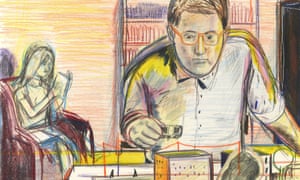
We frequently talk about craftsmanship along these lines: the craftsman had something he "needed to express", and after that he just, you know … communicated it. We become tied up with some variant of the purposeful misrepresentation: the idea that craftsmanship is tied in with having an obvious aim and after that certainly executing same.
The real procedure, in my experience, is considerably more baffling and to a greater extent a genuine annoyance to talk about honestly.
2
A person (Stan) builds a model railroad town in his storm cellar. Stan procures a little wanderer, places him under a plastic railroad connect, close to that phony open air fire, at that point sees he's masterminded his vagrant into a specific stance – the vagabond is by all accounts looking back at the town. Why is he investigating there? At that little blue Victorian house? Stan noticed a plastic lady in the window, at that point turns her a bit, so she's looking out. Over at the railroad connect, really. Huh. Abruptly, Stan has made a romantic tale. Goodness, for what reason wouldn't they be able to be as one? In the event that exclusive "Little Jack" would simply go home. To his better half. To Linda.
The author is that individual who, leaving upon her undertaking, does not realize what to do
Donald Barthelme
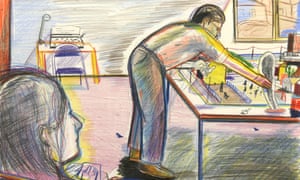
What did Stan (the craftsman) simply do? Indeed, to start with, studying his little area, he saw which way his beggar was looking. At that point he changed that little universe, by turning the plastic lady. Presently, Stan didn't precisely choose to turn her. It may be more exact to state that it struck him to do as such; in a brief moment, with no going with dialect, aside from perhaps a calm inward "Yes.He simply preferred it better as such, for reasons he couldn't well-spoken, and before he'd had sufficient energy or tendency to verbalize them.
A craftsman works outside the domain of strict rationale. Just knowing one's expectation and after that executing it doesn't make great craftsmanship. Craftsmen know this. As indicated by Donald Barthelme: "The essayist is that individual who, setting out upon her errand, does not comprehend what to do." Gerald Stern put it along these lines: "In the event that you begin to compose a sonnet around two pooches fucking, and you compose a ballad around two canines fucking – then you composed a lyric around two puppies fucking." Einstein, dependably the smarty-pants, exceeded them both: "No commendable issue is ever unraveled in the plane of its unique origination."

How, at that point, to continue? My technique is: I envision a meter mounted in my temple, with "P" on this side ("Positive") and "N" on this side ("Negative"). I attempt to peruse what I've composed uninflectedly, the way a first-time peruser may ("without trust and without lose hope"). Where's the needle? Acknowledge the come about without crying. At that point alter, in order to move the needle into the "P" zone. Authorize a monotonous, over the top, iterative use of inclination: watch the needle, change the exposition, watch the needle, modify the writing (flush, foam, rehash), through (at times) many drafts. Like a journey send gradually turning, the story will begin to change course by means of those a large number of incremental modifications.
The craftsman, in this model, resembles the optometrist, continually asking: Is it better this way? Or then again like this?
What a delight it is to be, on the page, to a lesser degree an idiot than normal
The intriguing thing, in my experience, is that the aftereffect of this arduous and marginally over the top procedure is a story that is superior to anything I am, "all things considered" – more amusing, kinder, less loaded with poop, more compassionate, with a clearer feeling of uprightness, both more shrewd and all the more engaging.
What's more, what a delight that is; to be, on the page, to a lesser degree an imbecile than common.
3
Reexamining by the strategy portrayed is a type of expanding the encompassing insight of a bit of composing. This, thusly, conveys a feeling of regard for your peruser. As content is reexamined, it turns out to be more particular and exemplified in the specific. It turns out to be more rational. It turns out to be less hyperbolic, wistful, and deceiving. It loses its capacity to make a propagandistic mist. Deceptions receive pressed in return, lethargic attestations stand up, exposed and reddening, and surge out of the room.
Is any of this significant to our current political minute?
When I state, "Weave was a butt hole," and after that, feeling this maybe to some degree ailing in specificity, overhaul it to peruse, "Sway snapped fretfully at the barista," at that point ask myself, looking for yet greater specificity, why Bob may have done that, and amend to, "Bounce snapped restlessly at the youthful barista, who helped him to remember his dead spouse," and afterward interruption and include, "who he missed so much, particularly now, at Christmas," – I didn't roll out that arrangement of improvements since I needed the story to be more merciful. I did it since I needed it to be less faltering.
In any case, it is more empathetic. Sway has gone from "unadulterated butt hole" to "lamenting widower, so heavyhearted that he has acted ungraciously to a youngster, to whom, regularly, he would have been decent". Weave has changed. He began a toon, on which we could stack hate, however now he is nearer to "me, on an alternate day".
How was this done? By means of quest for specificity. I directed my concentration toward Bob and, under the weight of making an effort not to suck, my composition moved toward specificity, and in the process my look turned out to be all the more cherishing toward him (ie, more delicate, nuanced, complex), and you, dear peruser, seeing my look turn out to be all the more adoring, may have discovered your own look winding up somewhat additionally cherishing, and together (both of us, helped by that fanciful malcontent) advised ourselves that it is workable for one's look to end up all the more adoring.
Or then again we could simply stay with "Bounce was a butt hole," and post it, and sit tight for the "preferences", and for the expert Bob powers to rally, and the counter barista trolls to secretly say something – yet, in the interim, there's poor Bob, lamenting and misjudged, and there's our poor manhandled barista, feeling crappy and not precisely knowing why, incrementally more persuaded that the world is unreasonably savage.
4
What does a craftsman do, generally? She changes what she's as of now done. There are those minutes when we sit before a clear page, however for the most part we're altering what is as of now there. The author reexamines, the painter contacts up, the executive alters, the artist overdubs. I express, "Jane came into the room and sat down on the blue love seat," read that, jump, cross out "came into the room" and "down" and "blue" (Why does she need to come into the room? Would someone be able to sit UP on a love seat? For what reason do we give it a second thought if it's blue?) and the sentence moves toward becoming "Jane sat on the love seat – " and abruptly, it's better (Hemingwayesque, even!), despite the fact that … why is it significant for Jane to sit on a lounge chair? Do we truly require that? Furthermore, soon we have arrived, essentially, at "Jane", which at any rate doesn't suck, and has the ethicalness of curtness.
In any case, for what reason did I roll out those improvements? On what premise?
On the premise that, if it's better this new path for me, here, now, it will be better for you, later, over yonder, when you read it. When I pull on this rope here, you reel forward over yonder.
This is a cheerful idea, since it infers that our brains are based on regular design – that whatever is available in me may likewise be available in you. "I" may be a nineteenth century Russian check, "you" low maintenance Walmart representative in 2017, in Boise, Idaho, however when you begin crying toward the finish of my (Tolstoy's) story "Ace and Man", you have demonstrated that we have something in like manner, transferable crosswise over dialect and miles and time, and regardless of the way that one of us is dead.
Another reason you're crying: you've recently understood that Tolstoy had a favorable opinion of you – he trusted that his own thoughts about existence here on earth would be detectable to you, and would move you.
Tolstoy envisioned you liberally, you rose to the event.
The compassionate capacity in fiction is proficient by means of the author's connection both to his characters and to his perusers
We regularly surmise that the compassionate capacity in fiction is refined by means of the author's connection to his characters, but at the same time it's expert through the essayist's connection to his peruser. You make a tenuous place (thin in dialect, in frame; culminated in numerous inarticulable delights – the way two scenes adjoin; a specific formal gadget that self-heightens; the ideal place at which a section cuts off); and afterward welcome the peruser in.

No comments:
Post a Comment